
By
George Spasov
October 22, 2026
8 minutes

Most traders started using AI by asking LLMs for research: explain a token, sum up market news or check why a price moved. That is changing. AI agents are shifting from answering questions to carrying out tasks, and crypto platforms are already enabling this type of interaction.
In 2026, leading DeFi apps Aave and Uniswap, along with major exchanges Coinbase and Binance, launched MCP servers and CLIs for users to act through AI agents. Mainstream brokers are moving the same way: Robinhood’s CEO Vlad Tenev said in July that AI agents will soon trade as well as humans, and over 150,000 customers have opened accounts for trading stocks, options and crypto through AI agents. Infrastructure is following too: BNB Chain is building a new blockchain designed for agentic trading, with its main network planned for early 2027.
AI is already part of how crypto traders work. In a September 2026 survey by MEXC, 85% of respondents said they had used AI for crypto research or trading and 13% had tried an AI agent connected to their exchange account. Another 50% said they were interested in trying it.
The idea for trading automation has evolved substantially in the past couple of years. In the past, trading bots have followed fixed, pre-set rules, such as buying when a price drops by a set amount. What’s new is that AI agents take a goal in plain language, work out the steps and carry them out across different platforms.
For crypto users, agents help in three practical ways: they cut down the steps a task takes, catch mistakes before funds move and do the comparison work across platforms. All three matter because funds rarely sit in one place. They are spread across exchanges, wallets and blockchains, each with its own interface, fees and rules.
Agents can turn a multi-step task into one request. Moving funds from a wallet on one blockchain to a trading platform on another can mean approving the transfer, bridging it (moving it between blockchains), waiting for it to arrive, switching networks and depositing, often across different apps. With an agent, the user describes the goal in a sentence and the agent works out the steps.
Agents can catch mistakes before they cost money. Every manual step leaves room for error: sending funds on the wrong network, sending less than a platform’s minimum deposit or running out of the token needed for network fees. An agent with access to balances and network data can check each step against the goal, for example whether there is enough of the fee token on the destination chain, and stop to ask before anything moves.
Agents can do the comparison work. Checking prices, routes, fees or lending rates across platforms takes time. An agent can gather the options, explain the trade-offs and recommend a course of action, leaving the decision with the user.
But there is a catch. All of this means trusting an agent with real money, and crypto transactions usually can’t be reversed. That shapes what users need to know before handing a task to an agent: what it can and can’t do on its own.
Letting an agent carry out a task means giving it a certain degree of access to accounts and funds. Three risks stand out, and each one grows with how much the agent can do without the user’s approval.
Keys in the wrong hands. If an agent holds private keys or API keys that can withdraw funds, anyone who takes control of the agent can move those funds.
Instructions hidden in what the agent reads. Agents read web pages, messages and documents, and can follow instructions hidden in them as if they came from the user. This is known as prompt injection.
A request read the wrong way. An agent can pick the wrong token (copycat tokens often share a ticker), the wrong app (fake copies of popular exchange and DeFi websites are common), the wrong network or the wrong amount. On a blockchain, a transfer like that usually can’t be reversed.
Traders seem to see limits as part of the answer. In the MEXC survey, the share of traders willing to let AI trade automatically rose from 55% to 72% when limits on funds, positions, leverage and losses were in place.
Each of these risks has a matching guardrail, and all three are worth having in place before an agent touches real funds.
Keep what the agent can reach small. Funds an agent works with can sit in a separate account or wallet with a modest balance. If the agent is compromised or misled, the damage stays within that amount.
Treat what the agent reads as untrusted. Instructions should come from the user, not from web pages or messages the agent reads along the way. Pointing the agent to official links for exchanges and apps, instead of letting it search for them, also keeps it away from copycat sites.
Check before anything irreversible. Before funds move, the user should see exactly what will happen: which token, which network, which destination and how much. Checking those details takes seconds and catches the kind of misread request described above.
The takeaway: agents need guardrails, meaning firm limits on what they can do on their own, where the agent plans and the user approves.
GoFin is built around that principle. It is a free, open-source CLI (command-line interface, a tool operated by typing text commands) built by LimeChain that sits between an AI agent and the user’s accounts.
The agent never holds the wallet private or API keys. They are kept by a separate component on the user’s computer, which only lets a request through if it stays within the user’s spending limits and, by default, has the user’s approval. The agent can plan actions, but it can’t carry them out on its own.
It also addresses a practical gap. Many exchanges and DeFi apps don’t offer their own interface for AI agents yet, and those that do only cover their own platform. GoFin lets agents like Claude Code, Codex, Hermes and OpenClaw work with exchanges, wallets and DeFi through one tool.
Take a common task: moving 1,000 USDC from Base to Hyperliquid. Done manually, that takes six steps across a wallet, a bridge and three networks. With GoFin CLI, it starts with one command to the agent.
Behind that command the agent turns the request into a plan: approve the USDC on Base, send it to Arbitrum, receive it there and deposit it into Hyperliquid. Before the plan runs, the user can see the amount, the route and the maximum network fee on each chain.
One Touch ID approval then sets in motion the whole plan, and only that plan. It applies to those steps, amounts and fee limits for a set period, so the agent can’t use it for anything else, and any change needs a new approval. GoFin then carries out each step, waits for the transfer between chains to complete and checks that the funds are available on Hyperliquid before reporting back.
The main benefit is a change in the user’s role. Instead of carrying out and monitoring six steps, switching networks and keeping track of fees on each chain, the user reviews one plan and approves it once.
GoFin also works with centralized exchanges, on their own or as one step in a longer plan. A user can simply buy ETH on Binance, or withdraw ETH from Coinbase, supply it to Aave, borrow USDC against it and deposit that USDC into Hyperliquid, with the whole route covered by one plan approval.


Three safeguards keep the user in control of what the agent can do:
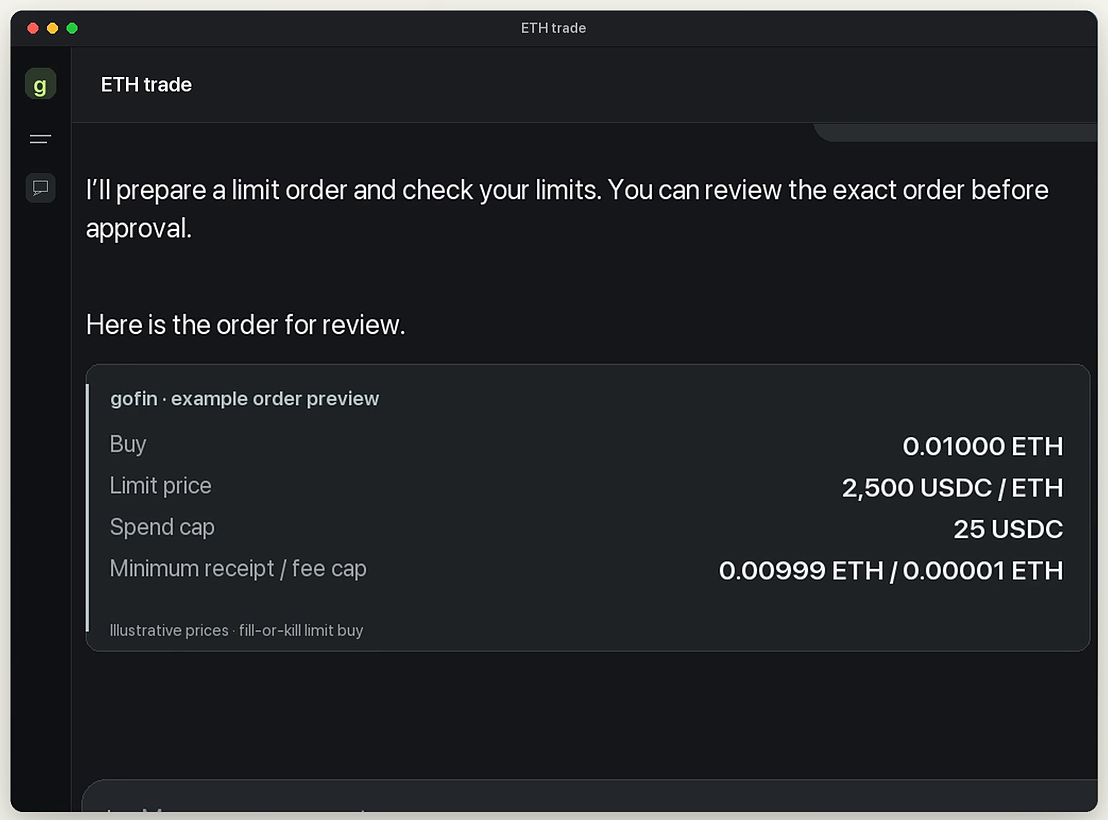
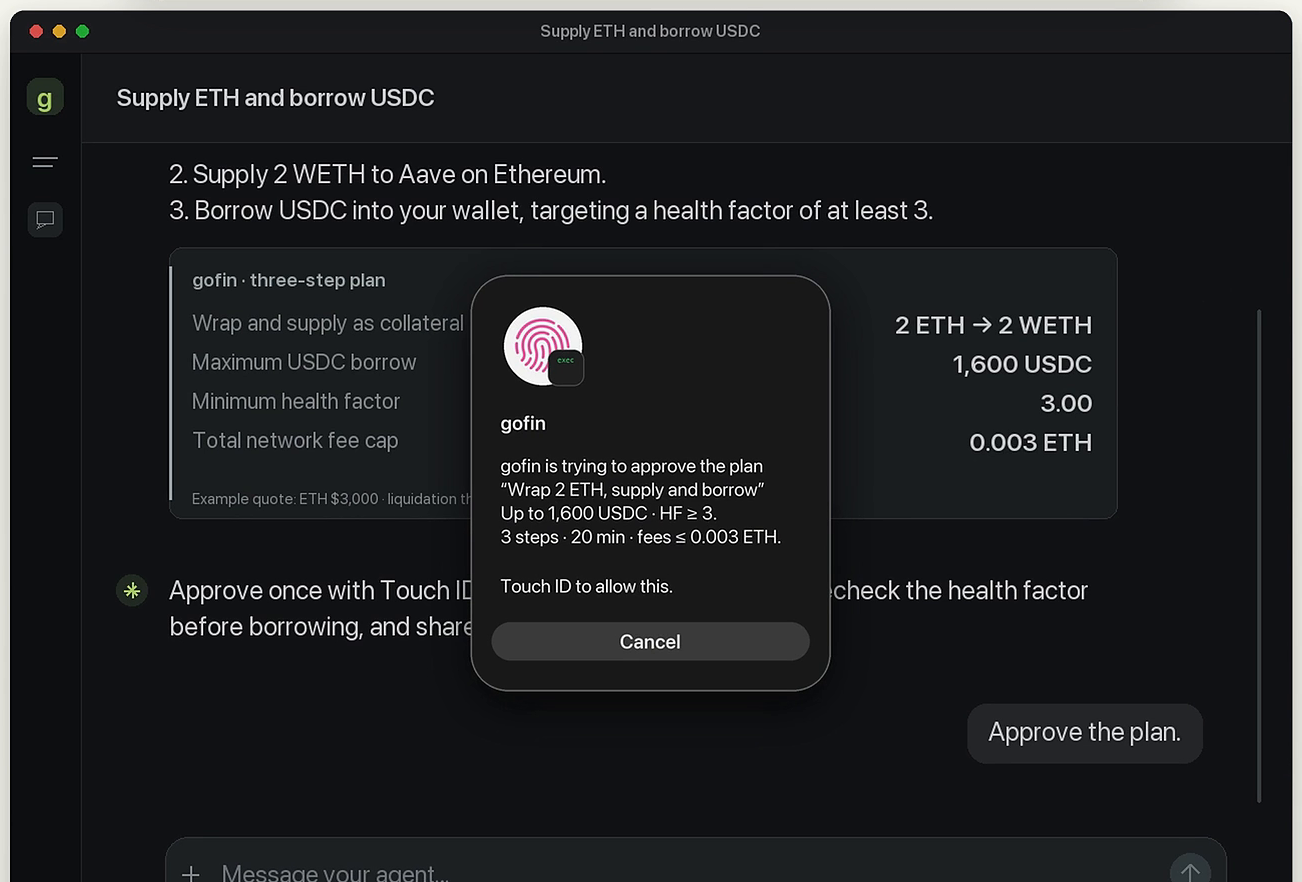
Together, these safeguards apply whatever the agent proposes. As with any tool that handles funds, they work best on a secure computer.
Agents already trade, move funds and compare options, and they are on track to become the main way people use crypto. More and more, users will tell an agent what they want instead of clicking through exchanges, wallets and DeFi apps, and the agent will act on their intent, within the limits they set.
That changes who crypto products are built for. Exchanges and protocols that make it easy for agents to find and use them in 2027, with clear interfaces and safe defaults, will gain the most as agent use grows.
We built GoFin to help crypto make that move faster and more safely. It is free and open source, so anyone can trade through their agent with these safeguards in place and build on the approach.
GoFin is available at gofin.sh, and feedback and contributions are welcome on GitHub.
An AI crypto trading agent is an AI assistant that carries out crypto tasks instead of only answering questions. Given a goal in plain language, it works out the steps, such as checking balances, comparing routes or placing an order, and carries them out through the user’s exchange and wallet accounts. The safest setups keep keys away from the agent and require the user’s approval before funds move.
MCP (Model Context Protocol) is an open standard for connecting AI assistants to outside tools and data. An MCP server lets any compatible agent use an app’s features without a separate integration for each assistant, which is why platforms such as Aave and Kraken have launched them. Command-line tools are another option, and some connect an agent to several exchanges and DeFi apps through one tool.
Only the permissions the task needs. For most agent tasks, that means viewing balances and placing orders, with withdrawals switched off, as exchanges such as Kraken recommend. Where the key is stored matters too. A key the agent can read can leak through a mistake or a prompt injection, so it’s safer kept somewhere the agent can’t access, with the agent only sending requests.
Start with access that can’t move funds. A read-only connection lets an agent check balances and prices without trading, paper trading simulates orders against live prices, and some platforms offer test networks with mock funds. When moving to real money, a low spending limit per action and a preview of each trade before approval keep any mistake small.
Mostly the user. An agent acts with the access the user gives it, and platforms that offer agent trading generally leave it to users to decide what agents can do. Because crypto transactions usually can’t be reversed, guardrails matter: spending limits the agent can’t change and an approval step before funds move, so the user signs off on what the agent proposes.
Or just shoot us a message on Telegram


