
By
Andrea Candela
December 19, 2025
5 minutes

Fresh off the stage at the BlueChip: The Crypto Safety Conference (2025), one of our DeFi product managers, Alex Vankov, delivered a keynote that cut through the noise of the "next big thing" in finance. He didn't just talk about technology; he talked about solving the single biggest bottleneck in the world's largest financial market: Over-the-Counter (OTC) Derivatives.
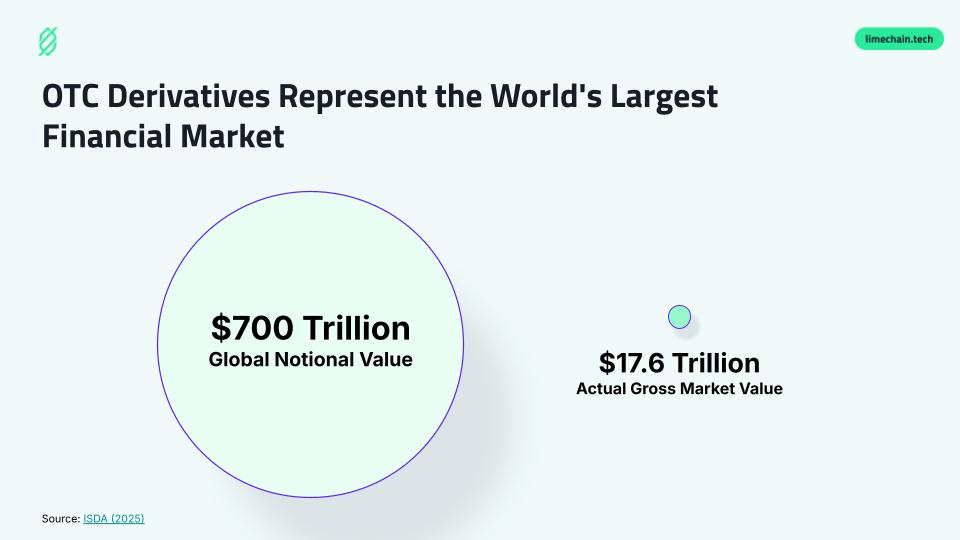
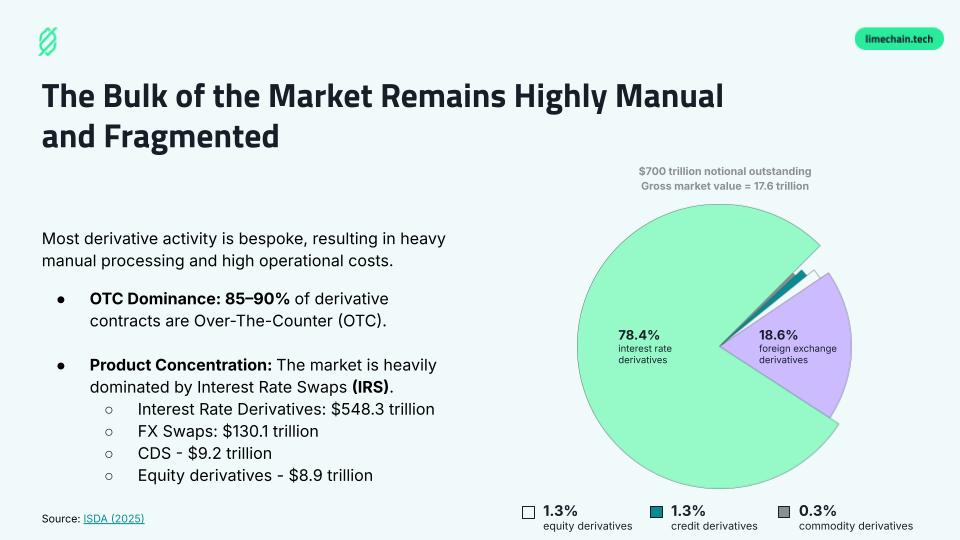
For those outside the inner circle of high finance, the scale of this market is hard to wrap your head around. We are talking about a $700 trillion notional value—the bedrock of global risk management. Yet, 85-90% of this activity remains trapped in highly manual, fragmented, 1990s-era infrastructure.


While the notional value is staggering, the actual gross market value sits at $17.6 trillion. Today, this entire system relies on the Credit Support Annex (CSA)—a complex legal document that governs how collateral moves when prices change.
The issue? It’s slow. It’s manual. And it’s incredibly expensive. Because of Counterparty Credit Risk (CCR) and T+1 settlement delays, financial institutions are forced to "freeze" massive amounts of capital. In Europe alone, CCR and Credit Value Adjustment (CVA) requirements lock up nearly EUR 95 billion in capital annually for financial institutions.
Alex’s keynote introduced a paradigm shift: Smart Contract Derivatives. Think of it as taking that complex, 50-page paper CSA and turning it into a self-executing instruction manual on a distributed ledger.
By utilizing two specific technical standards, we can transform these "static" legal agreements into "programmable" assets:
Shifting to smart contracts offers three distinct advantages:
This isn't just theory. The Decentralized Finance (DeFi) space is already proving the model works at scale:
At LimeChain, we’ve spent the last 8 years building the bridge between these "DeFi" breakthroughs and institutional reality. With a team of 175+ experts and over 285 projects under our belt—for names like Ethereum, Solana, and P&G—we don't just build code; we build the future of market infrastructure.
The adoption of blockchain in finance is no longer a choice; it’s an inevitability. The goal is to move proactively, building auditable pilots that prove the business case while keeping regulators and internal audit aligned from day one.
The Over-the-Counter (OTC) Derivatives market, which has a staggering notional value of $700 trillion, is currently hamstrung by outdated infrastructure. Despite its size, 85-90% of activity in this market is trapped in manual, fragmented systems reminiscent of the 1990s.
The current system is described as a $17.6 trillion "Wait-and-See" game. Because the market relies on manual Credit Support Annex (CSA) documents and suffers from T+1 settlement delays, financial institutions face significant Counterparty Credit Risk (CCR). Consequently, institutions are forced to "freeze" massive amounts of capital; in Europe alone, CCR and Credit Value Adjustment requirements lock up approximately EUR 95 billion annually.
You can think of a Smart Contract Derivative as a "self-driving" financial instrument. It functions by taking the complex, physical Credit Support Annex—often a 50-page legal document—and transforming it into a self-executing instruction manual that lives on a distributed ledger.
The transition involves two key "programmable" standards:
Shifting to smart contracts offers three distinct advantages:
Yes, the Decentralized Finance (DeFi) sector has provided strong evidence of viability. For example, Pendle, which handles interest rate swaps, saw its Total Value Locked (TVL) increase by 184% to 7.12 billion in a single year. Similarly, Morpho (lending and borrowing) achieved 364% YOY TVL growth to 11.6 billion.
Or just shoot us a message on Telegram


